(21 views)
Introduction
Your next client is not scrolling through page one of Google. They typed a legal question into a search bar, got an AI-written summary at the very top of the page, and either called one of the firms mentioned in it — or went back to ask ChatGPT for more detail. Either way, if your firm was not in that summary, you were invisible. That is the new reality of legal search in 2026.
This is not a slow shift — it already happened. Google AI Overviews are now a permanent fixture on search results pages, appearing before ads, before the map pack, and before every organic result your firm worked years to earn. At the same time, a significant share of prospective clients — especially those in the 25–45 age bracket — are bypassing Google entirely and asking their legal questions directly to ChatGPT or Perplexity. They want answers, not a list of websites to click through.
The firms that understand this shift and act on it now are the ones that will own their local market in the next two to three years. This guide gives you the full picture — not just tactics, but the strategic framework that legal marketing actually requires in an AI-driven search environment.
What Google AI Overviews Are — and Why They Fundamentally Changed Legal Search
Google AI Overviews are not just a redesigned featured snippet. They are a generative AI system trained to scan the highest-quality sources on a topic, synthesize a useful answer, and present it in a formatted summary — with attribution links — at the very top of the search results page. On legal queries specifically, they appear with striking regularity. Searches like "how long does a personal injury case take," "can I sue my employer for wrongful termination," or "what is the statute of limitations in Florida" now almost always trigger an AI Overview before showing a single website.
What makes this different from the old featured snippet is scope and competition. A featured snippet showed one answer from one page. AI Overviews synthesize multiple sources and show three to five attribution links alongside the answer. The firms whose pages are cited receive prominent visibility — essentially a position above position one. The firms whose pages are not cited get buried below the AI summary, the ad block, and the local map pack. For many queries, non-cited results effectively receive no traffic at all.
""AI Overviews don't care how big your ad budget is. They pull from sources they trust — and trust is built through content quality, not spend.""
The same dynamic is playing out across AI-native tools. ChatGPT's browsing mode, Perplexity AI, and Microsoft Copilot all pull from external websites when answering legal questions. None of these tools accept payment for inclusion. Appearing in their answers is entirely determined by whether your content is deemed trustworthy, current, and genuinely useful — which means law firm SEO has become, at its core, a content credibility problem.
""AI Overviews don't care how big your ad budget is. They pull from sources they trust — and trust is built through content quality, not spend.""
The same dynamic is playing out across AI-native tools. ChatGPT's browsing mode, Perplexity AI, and Microsoft Copilot all pull from external websites when answering legal questions. None of these tools accept payment for inclusion. Appearing in their answers is entirely determined by whether your content is deemed trustworthy, current, and genuinely useful — which means law firm SEO has become, at its core, a content credibility problem.
⚖️ Legal Marketing Context
Google classifies legal content as YMYL — "Your Money or Your Life." This is the same scrutiny tier as medical and financial content. It means generic, unattributed, or vague legal content gets systematically deprioritized in AI source selection. The bar for what earns a citation is genuinely higher for attorneys than it is for most other industries.
The old SEO playbook no longer works for attorneys
Five years ago, a law firm could rank on page one by targeting the right keywords, getting a handful of directory backlinks, and publishing a few practice area pages. That model still has some value — but it no longer determines who gets cited in AI Overviews. The AI systems evaluating your content are asking different questions: Does this website comprehensively cover this practice area? Is the author a qualified, named attorney? Has this content been updated recently? Does it answer the specific question being asked, or does it just mention the keywords?
Firms that haven't adjusted their strategy yet are losing ground daily to competitors who have. The gap is real — and it's widening.
Topical Authority: The Strategic Foundation of Law Firm SEO in 2026
If there is a single concept that defines where law firm SEO is in 2026, it is topical authority. Google and AI tools do not evaluate your website page by page. They look at your entire domain and ask: does this firm demonstrate genuine expertise in a specific area of law, or do they have a scattered collection of thin, generic pages? Depth in one area outperforms breadth across many — every time.
Topical authority is built when your website covers a subject area so completely that someone navigating it would get a genuinely comprehensive understanding of the topic — including the questions they didn't know to ask. For a personal injury firm, that means not just a "Personal Injury" landing page, but a connected ecosystem of content that covers every angle a real client might encounter:
When your website answers all of these questions — not in isolation, but interlinked and organized — Google treats your domain as the authority on that subject. That authority is what earns citations in AI Overviews, because the AI system is selecting the most complete, most credible source available. Breadth of coverage signals expertise in a way that a single optimized page never can.
- What to do in the 72 hours after an accident — and the specific mistakes that kill compensation claims
- How comparative negligence laws in your state affect what a client can actually recover
- The real timeline of a personal injury claim — from demand letter to settlement or trial
- What insurance adjusters are trained to do when minimizing a payout — and how experienced counsel counters it
- The difference between economic and non-economic damages, explained for a non-lawyer
- When a case is likely to settle versus go to trial, and what factors drive that decision
- How to evaluate a contingency fee agreement before signing
When your website answers all of these questions — not in isolation, but interlinked and organized — Google treats your domain as the authority on that subject. That authority is what earns citations in AI Overviews, because the AI system is selecting the most complete, most credible source available. Breadth of coverage signals expertise in a way that a single optimized page never can.
📌 Real-World Example
Nolo.com consistently appears in AI-generated answers across Google, ChatGPT, and Perplexity — not because it has the highest ad spend or the oldest domain, but because it covers legal topics exhaustively, attributes content to named legal professionals, and updates regularly. A regional personal injury firm or a boutique family law practice can build this exact kind of authority within a focused niche. The advantage is that Nolo covers everything; your firm only needs to dominate one area.
Depth over breadth — the critical strategic choice
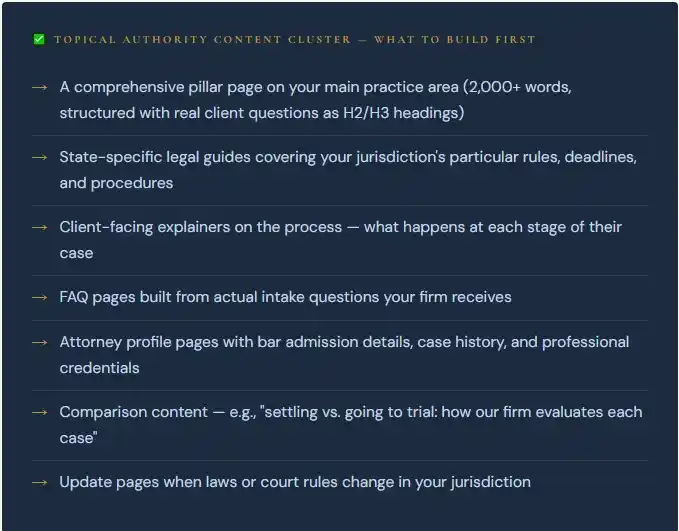
Most law firms make the mistake of trying to build topical authority across every practice area they offer simultaneously. The result is diluted effort and mediocre content across the board. The better approach is to identify your highest-revenue or most competitive practice area, build a comprehensive content cluster around it — ideally 15 to 25 interconnected, genuinely useful pieces — establish authority there, and then expand methodically. A firm that owns personal injury in a mid-sized city will generate significantly more AI-cited visibility than a firm that has two pages each on five different practice areas.
How to Get Your Law Firm Cited in AI Overviews — The Practical Framework
Structure your content to answer before it explains
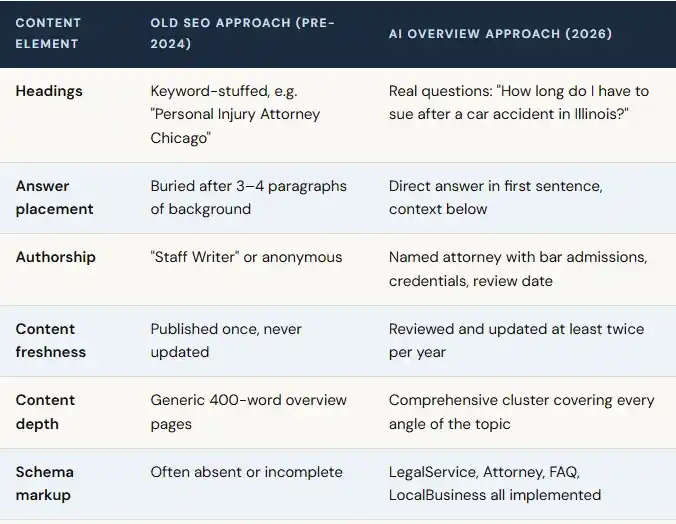
AI Overviews are extraction systems. They look for clear, direct answers — and if your page doesn't provide one early, the system moves on to a page that does. The most effective content structure for AI citation is also the most readable one: state the direct answer in the first one or two sentences under a heading, then provide the context, exceptions, and depth below it. Think of how a good legal brief is structured — conclusion first, reasoning second. That is the exact format AI systems reward.
Practically, this means converting your most common client questions into literal H2 and H3 headings — not "Statute of Limitations Overview" but "How long do I have to file a personal injury lawsuit in Texas?" Then answering it in the very first sentence under that heading. Then going deeper with the nuance — exceptions for minors, discovery rules, tolling provisions. That structure is what gets extracted and cited.
Use real client language, not legal terminology
There is a persistent tension in legal content between professional credibility and accessibility. The firms that get cited in AI Overviews have resolved it: they write in plain language without sacrificing accuracy. Prospective clients are not searching for "tortious interference claims" — they are searching for "what to do if a competitor is stealing my clients." Writing for how real people ask questions is not dumbing down your content. It is calibrating it for the audience that actually searches for it.
There is a persistent tension in legal content between professional credibility and accessibility. The firms that get cited in AI Overviews have resolved it: they write in plain language without sacrificing accuracy. Prospective clients are not searching for "tortious interference claims" — they are searching for "what to do if a competitor is stealing my clients." Writing for how real people ask questions is not dumbing down your content. It is calibrating it for the audience that actually searches for it.
Keep content current — AI tools penalize stale information
AI Overviews and AI chatbots have a strong decency bias. Legal content that hasn't been reviewed or updated since 2022 or 2023 is increasingly being passed over in favor of more current sources. This doesn't mean you need to publish new articles weekly. It means your most important pages — the ones targeting your core practice areas — should be reviewed and updated at minimum twice a year. Update the date, verify all statutes and case references, and add any recent legal developments in your jurisdiction. A visible "Last reviewed by [Attorney Name] — [Month Year]" line at the top of the page provides both a trust signal and a freshness indicator that AI systems register.
E-E-A-T for Legal Content: Why Google Holds Your Firm to the Highest Standard
Google's quality evaluator guidelines use a framework called E-E-A-T — Experience, Expertise, Authoritativeness, and Trust. Legal content sits in the highest-scrutiny category of this framework, alongside medical and financial content. The reason is consequential: bad legal information can cause serious harm to real people. Because of this, Google's AI systems are specifically trained to prioritize content that demonstrates real, verifiable legal expertise over content that merely sounds authoritative.
For a law firm, this means every piece of content on your website should make it unmistakably clear who wrote it and why they are qualified to write it. Every practice area article should carry the name of the specific attorney who authored it, their state bar admissions, their years of experience in that area, and a date indicating when the content was last reviewed. Reference actual statutes. Cite relevant case outcomes where appropriate. The more your content reads like it was written by a real attorney who knows this area of law deeply — rather than a generic template — the higher it will rank in AI citation selection.
For a law firm, this means every piece of content on your website should make it unmistakably clear who wrote it and why they are qualified to write it. Every practice area article should carry the name of the specific attorney who authored it, their state bar admissions, their years of experience in that area, and a date indicating when the content was last reviewed. Reference actual statutes. Cite relevant case outcomes where appropriate. The more your content reads like it was written by a real attorney who knows this area of law deeply — rather than a generic template — the higher it will rank in AI citation selection.
⚠️ Common E-E-A-T Mistakes in Legal Marketing
The single most common E-E-A-T failure we see in law firm websites: attorney bio pages that list accolades but don't link to actual authored content; practice area pages with no named author at all; articles that reference "the law" without citing specific statutes; and content that was accurate in 2021 but has never been touched since. Any one of these is enough to prevent AI citation. All four together essentially guarantee invisibility in AI Overviews.
Link authority in the legal vertical — quality over quantity
In legal SEO, the source of a backlink matters enormously. A single link from your state bar association's website, a recognized legal news outlet, or an academic institution carries more weight than 200 links from generic blogs. AI systems partly determine who to trust by watching what already-trusted sources reference.
Build your link profile deliberately: pursue citations from Avvo, Martindale-Hubbell, Justia, Super Lawyers, your local bar association, legal trade publications, and any civic or professional organization your attorneys are genuinely involved with. Guest articles in local legal journals are also exceptionally effective for authority building in a way that general link-building can never replicate.
Build your link profile deliberately: pursue citations from Avvo, Martindale-Hubbell, Justia, Super Lawyers, your local bar association, legal trade publications, and any civic or professional organization your attorneys are genuinely involved with. Guest articles in local legal journals are also exceptionally effective for authority building in a way that general link-building can never replicate.
Ranking on ChatGPT, Perplexity, and AI-Native Search Tools
Google is still the dominant search platform, but the search behavior of prospective legal clients has meaningfully fragmented. A growing segment of your potential clients — particularly in the 25–45 demographic — are asking their legal questions directly to ChatGPT, Perplexity, or Microsoft Copilot without ever opening a search engine. They want a conversation, not a list of links. Understanding how these tools select sources is now a legitimate part of legal marketing strategy.
These AI tools do not use Google's ranking algorithm. They have their own indexing and source-evaluation systems — but the fundamentals that earn trust are strikingly similar: content that is comprehensive, attributed to real experts, current, well-structured, and cited by other credible sources. A few specific considerations are worth building into your strategy:
External citation footprint matters — AI tools don't just look at how well your site ranks in Google. They evaluate how widely your content is referenced across the web. Being cited in legal publications, mentioned in local news coverage, and linked from authoritative directories all expand your citation footprint on AI-native tools.
Content freshness is weighted heavily — ChatGPT's browsing mode and Perplexity both prefer recent sources. Content that hasn't been updated in more than 12–18 months is actively deprioritized. Regular content reviews are not optional in an AI-native search environment.
Conversational content structure performs best — AI chatbots reward content that mirrors how humans actually phrase questions. FAQ sections, Q&A-structured guides, and content organized around real intake questions all perform better in AI-native retrieval than traditional keyword-targeted pages.
Anonymous content is functionally invisible — On AI-native tools even more than on Google, unattributed legal content carries no authority. Named attorneys with visible credentials and verifiable bar memberships are the standard these tools expect.
🔍 Practical Test You Can Run Today
Open ChatGPT or Perplexity and type in two or three questions that your ideal client would ask — the kind you hear during intake calls. See whose content is being cited. If your firm isn't in those answers but a competitor or a legal information website is, that is your content gap. Those are the exact questions you need to build detailed, attorney-attributed content around — and they are likely high-converting queries that you're currently invisible for.
Local SEO for Law Firms in 2026: What Has Changed and What Still Drives Clients
The vast majority of legal clients are searching for local representation. "Divorce attorney in Chicago," "criminal defense lawyer Austin TX," and "immigration attorney near me" remain among the highest-converting searches in legal marketing. What has changed is the infrastructure around those searches.
AI Overviews now appear on local legal queries — and they pull from a combination of your website content, your Google Business Profile, your directory listings, and your client reviews. Dominating just one of these touchpoints is no longer sufficient. Legal clients now encounter your firm across multiple AI-influenced surfaces before they ever visit your website.
AI Overviews now appear on local legal queries — and they pull from a combination of your website content, your Google Business Profile, your directory listings, and your client reviews. Dominating just one of these touchpoints is no longer sufficient. Legal clients now encounter your firm across multiple AI-influenced surfaces before they ever visit your website.
Google Business Profile — the most underutilized asset in legal marketing
An incomplete or poorly managed Google Business Profile is a significant competitive disadvantage in 2026. This is not just a directory listing — it is a structured data source that Google's AI draws from when constructing local AI Overview answers and local knowledge panels. Every field matters: practice area categories, service descriptions, Q&A responses, business hours, and post activity all contribute to your profile's authority signal. A profile treated as a set-and-forget listing is actively costing your firm visibility every day.
Review strategy is now a rankings strategy
Client reviews affect local SEO in two distinct ways that most firms underappreciate. First, the aggregate authority of your Google Business Profile — influenced heavily by review volume and recency — affects where you appear in local packs, which frequently appear directly adjacent to AI Overview answers on local legal queries. Second, the specific language in your reviews provides topical relevance signals.
A review that says "helped me navigate my wrongful termination case and secured a settlement I never expected" tells Google's AI system something substantively different about your firm than "highly recommend, very professional." Encouraging clients to describe their experience specifically — not to coach them on keywords, but simply to be descriptive — has a measurable SEO effect.
A review that says "helped me navigate my wrongful termination case and secured a settlement I never expected" tells Google's AI system something substantively different about your firm than "highly recommend, very professional." Encouraging clients to describe their experience specifically — not to coach them on keywords, but simply to be descriptive — has a measurable SEO effect.
Real location pages, not swapped-city templates
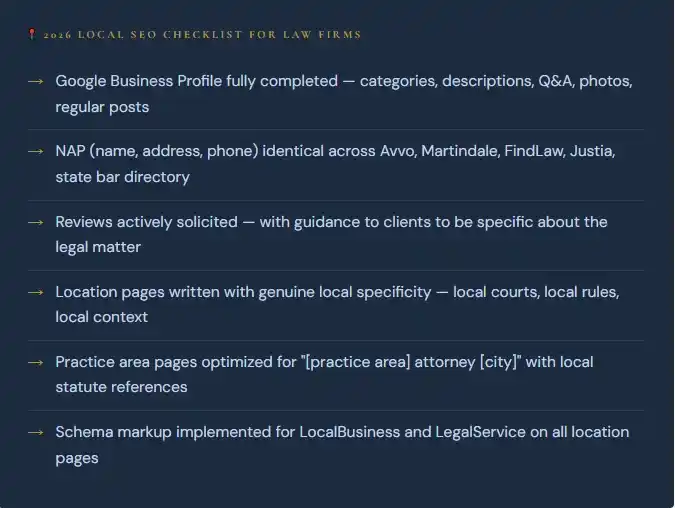
If your firm serves multiple cities or counties, each location needs a page that is genuinely different — not a template with the city name changed. Mention the specific courts you appear in regularly. Reference local rules or procedural nuances in that county. Discuss local industries or demographics that are relevant to the legal issues your clients face there. Google's AI systems can detect duplicate-pattern content across city pages with high accuracy, and they deprioritize it accordingly. Real, locally-specific content is the only version that earns local AI Overview citations.
Schema Markup for Legal Websites: The Technical Edge Most Firms Ignore
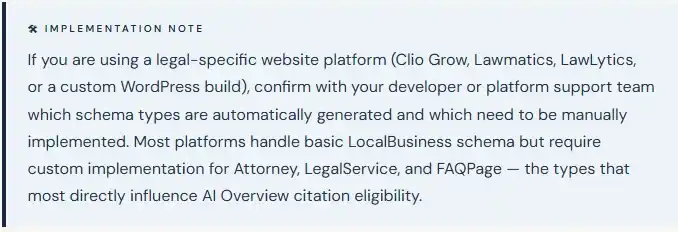
Schema markup is structured code that lives in the backend of your website pages and tells search engines — in machine-readable language — exactly what your content means. It doesn't change anything your visitors see. What it changes is how accurately and completely Google's AI can interpret your site when deciding whether to cite it. For law firms, the most valuable schema types are: LegalService (describes your firm and practice areas in structured format), Attorney (credentials, bar admissions, practice areas for each attorney), FAQPage (structured Q&A that feeds directly into AI Overview FAQ formats), LocalBusiness (address, phone, service area, hours), and Article with author attribution for all editorial content.
The competitive reality is that a majority of law firm websites still do not have schema markup implemented correctly — or at all. This is one of the clearest areas where a technically sound implementation can create a visible, measurable advantage in AI Overview citation rates within a relatively short timeframe. It is also one of the less glamorous parts of SEO that marketing agencies frequently skip in favor of content production, which is why it remains a genuine gap even among well-resourced firms.
The Firms That Win in 2026 Are Building Trust Right Now — Not Later
The underlying logic of AI-driven search rewards exactly what good legal practice has always required: genuine expertise, clear communication, and a visible commitment to being useful to the people you serve. The technical elements — schema markup, content structure, E-E-A-T signals — are real and they matter. But they are scaffolding around a simpler core principle: build content that a stressed, confused person could read and come away feeling actually helped, written by an attorney whose credentials are visible and verifiable.
The firms building that foundation right now are accumulating a compounding authority advantage that becomes increasingly difficult to displace. The window where this kind of positioning is still available — before it becomes the standard expectation and the competitive bar rises further — is still open. The question is which firms in your market are going to use it.
Is your law firm appearing in AI Overviews? Get a free, no-obligation SEO audit tailored for attorneys. Discover your visibility gaps, missed opportunities, and exactly what to prioritize next
FAQs
AI Overviews SEO means structuring your website so Google's AI selects it as a cited source in the summary answers that appear above all organic results. Legal queries trigger AI Overviews at nearly 78% — the highest rate of any industry — making this the most valuable visibility opportunity available to law firms today.
In 2026, the goal has shifted from ranking a page to becoming a trusted source AI systems feel confident citing. Topical authority — how completely your site covers a practice area — now matters more than keyword density or raw backlink count. Named attorney authorship, current content, and answer-first structure are the real differentiators.
Yes. AI Overviews favor content quality over firm size or ad budget — boutique firms with focused niche expertise are already outranking large regional competitors. A solo attorney who dominates one practice area in one market with detailed, credible, attorney-attributed content has a fully achievable path to consistent AI citation.
Most law firms begin seeing citation movement within 6–9 months, with high-competition markets like personal injury in major metros taking up to 12 months. Firms that focus on one practice area first and build a complete content cluster reach the authority threshold significantly faster than those spreading effort across multiple areas.
Reviews don't directly trigger website citations in AI Overviews, but they strengthen your Google Business Profile authority and local pack placement — which sits directly adjacent to AI Overview answers on local legal queries. Reviews that name specific practice areas also reinforce topical relevance signals Google's AI uses to evaluate your firm.
The most common failure is burying the answer. AI systems extract 1–3 sentences per source and skip pages that don't deliver a clear answer within the first 50–80 words of a section. Restructuring existing content to answer first, then explain — without adding a single new page — is often the fastest path to AI Overview citation for law firms.
The highest-priority schema types for legal sites are LegalService, Attorney, FAQPage, and LocalBusiness. FAQPage schema is especially valuable — it feeds directly into Google's People Also Ask results and signals structured Q&A content to AI Overview systems. Most law firm websites still lack these entirely.
AI-generated content is not penalized by default, but Google's 2026 algorithms heavily prioritize E-E-A-T — content that demonstrates real attorney experience, not generic AI output. Legal content that lacks named authorship, specific statutory references, and jurisdiction-specific detail will be deprioritized regardless of how it was produced.